Disinfection and Sanitisation in Al Harazat

Disinfection and Sanitisation in Al Harazat, Jeddah

Al Harazat is a densely built apartment district on former farmland near the Old Makkah Road in south eastern Jeddah. Low rise apartment blocks and popular housing line narrow streets, where hundreds of residents share one building, common corridors, lifts and staircases. Disinfection here cannot focus only on individual flats, because shared surfaces transfer infection between units every day, and those corridors and stairs are where the contamination actually spreads.

  • A full team, not one person
  • Price agreed before we start
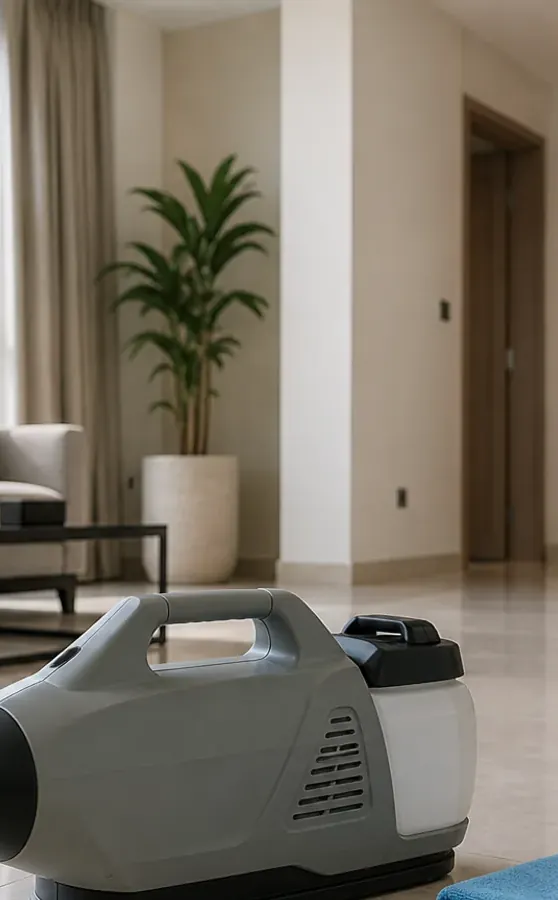
  • Foggers and products we bring
  • Reworked in the same visit

What changes about disinfection and sanitisation in Al Harazat

Narrow streets and unplanned layout trap dust and moisture throughout the district, so apartment blocks experience faster accumulation of contaminants than open villa-only neighbourhoods do, creating visible grime on common surfaces. For the method itself, see our disinfection and sanitisation service in detail.

  • The first reason

    Shared staircases, corridors and lifts

    One apartment block houses dozens of families, and every day children, workers, nurses and household staff climb the stairs and use shared corridors and lifts. Stair rails, lift buttons, door handles and common surfaces transmit infection rapidly between flats, so these must be disinfected first and thoroughly before work begins on individual units.

  • The second reason

    Centralised piping and shared drainage

    One building channels all drainage through shared pipes. Bacteria colonise the pipes and spread between flats, so treating the drains is the foundational step before any flat-level work, because recontamination from the pipes will follow otherwise.

  • The third reason

    Dampness and stagnant air in corridors

    Narrow streets and dense building layout do not permit good air circulation through corridors and stairwells. Humidity accumulates and stagnant air traps fumes, so ventilation after disinfection requires active management rather than passive window opening.

What disinfection and sanitisation covers in Al Harazat

Growth on former farmland with unregulated subdivision means weak drainage and damp soil beneath the buildings, affecting flat humidity and ventilation, and trapping dust in narrow streets that do not allow air circulation.

  • Cleaning before disinfecting

    Cleaning before disinfecting

    Cleaning before disinfecting must focus on fine dust from narrow streets where dust is trapped and accumulates, as surface rinsing alone is insufficient to prepare surfaces for effective disinfectant application.

  • The surfaces hands touch most

    The surfaces hands touch most

    High-touch surfaces such as stair railings, lift buttons, door handles and common light switches are touched by hundreds of hands daily and represent the primary vector for disease transmission in the building.

  • Bathroom taps and handles

    Bathroom taps and handles

    Bathrooms may show dampness from shared pipes inside the common walls, and mould can reappear quickly after disinfection if the source moisture from central drainage is not also addressed.

  • Kitchen and food surfaces

    Kitchen and food surfaces

    Kitchen and food preparation surfaces collect fine dust from the narrow street, especially if the district is near a commercial street or shops serving the residents nearby.

  • Drains and grout lines

    Drains and grout lines

    Drains and grout lines in interconnected flats share the main drainage system, so bacteria transfer easily between units through centralised plumbing rather than remaining isolated to one flat.

  • Contact time, then ventilation

    Contact time, then ventilation

    Contact time may extend because humidity from dense building construction and shared piping slows drying, and ventilation requires active intervention because narrow corridors do not allow natural air flow.

Not included

  • Deep cleaning of heavy grease, clutter or built-up stains, a separate service
  • Mould remediation inside walls, ceilings or plumbing
  • Pest treatment, a different service with different materials
  • Medical-grade sterilisation of instruments or equipment

How disinfection is actually done

  1. 1

    We ask what happened, then plan for it

    A move-in, an illness and an after-party aren't the same job.

  2. 2

    Clean the surface before disinfecting

    Grime and grease shield what's under them.

  3. 3

    Contact time, not just a wipe

    A disinfectant has to stay wet on the surface to work.

  4. 4

    High-touch points by hand

    Handles, switches, taps and rails are done by hand because they carry the most and need direct contact that fogging alone doesn't give.

  5. 5

    Fog the air and soft furnishings

    Once the hard surfaces are done, a fine fog reaches the air, the fabrics and the corners a cloth can't, settling over what hand-wiping misses.

  6. 6

    Ventilate, then walk it with you

    We open up and air the rooms, then walk the home with you before leaving.

Al Harazat on the map

Al Harazat sits about 4.5 km from Al Qaws and about 4.5 km from Um Al Salam.

Open in Google Maps

Why us for this service in particular

Clean first, then disinfect

The common mistake is spraying disinfectant over dirt.
A full team arrives together

The company runs a large crew, and we send a team rather than one person.

Our foggers and products

The foggers and the products come with the team.

We say no when it's no

If what you need is deep cleaning or mould work rather than disinfection, we tell you.

From our work

Photographs from real jobs carried out by the crew.

A bedroom after a full clean
Bedroom at handover
Majlis carpet after washing
Majlis after washing
A majlis after a full clean
Majlis after cleaning
A living room after cleaning
Living room after cleaning
A sitting room after cleaning
Sitting room
A folded towel on a table
The small details
A tidy bedroom after service
Bedroom made up
Mopping a marble floor during work
Marble floors
Washing a stone entrance
Exterior entrances
Cleaning a commercial floor
Commercial floor
Making the bed during work
Bed made
A jacuzzi after descaling
Jacuzzi after cleaning

The job isn't closed until you approve it

The commitment is simple enough to actually keep: we don't leave until you've seen the result and had your say on it.

The character of Al Harazat

Apartment district: residential blocks, repeated floors and shared entrances

In a dense apartment district like Al Harazat, disinfection is not an individual action because flats are joined and pipes are shared. Disinfecting your flat alone does not protect you if corridors, stairs, lifts and pipes remain contaminated, because infection returns from the common areas immediately after treatment.

Questions about disinfection and sanitisation in Al Harazat

Does disinfecting just my flat protect me if other residents in the building are ill?

No. Infection travels through shared corridors, stairs, lift surfaces and common pipes, so your flat recontaminates immediately from the corridor. Disinfecting corridors and stairs is as essential as treating your flat, or the infection returns within hours.

Does dampness from shared piping affect every flat in the building equally?

Yes. Shared pipes mean moisture, odour and bacteria reach every unit. Even if you disinfect your flat, dampness and smell return from the pipes inside the shared walls, negating surface treatment.

Does a ground floor flat need different disinfection from upper floors?

Yes. Ground floors sit closer to damp soil and main pipes, so they often experience higher humidity. Upper floors dry faster, but shared rails and pipes remain common to all units, so the infection vector is the same.

Does dust from the narrow street enter a flat here faster than dust in villa neighbourhoods?

Yes. Narrow streets trap dust and grit, and daily traffic from cars and motorbikes releases much dust. Cleaning and disinfection need faster repetition here than in open, quieter areas.

Do the mosque and health centre in the district affect how we disinfect the home?

Not directly, but high foot traffic means more dust in streets and entries, so the flat recontaminates faster than in quieter neighbourhoods, requiring shorter intervals between treatments.

Is disinfecting a flat twice yearly enough in a dense apartment district?

It depends on occupancy and the number of young children. Dense districts mean faster contamination rates, so you may need disinfection more than twice yearly if the flat has small children who bring home dust and illness daily.

Is this the same as deep cleaning?

No. Deep cleaning removes built-up dirt, grease and stains. Disinfection reduces germs on surfaces that are already clean. We clean the surface as part of disinfecting, but heavy build-up is a separate deep-clean job, and we'll say so if that's what you need.

Can you disinfect after someone has been ill?

Yes, and it's one of the more common reasons people call. We focus on the high-touch points and shared surfaces where illness lingers, clean them first, then treat with contact time. Tell us which rooms the person used most so we concentrate there.

How much does disinfection and sanitisation in Al Harazat cost?

It is set after the inspection, because it follows the size of the job, the materials involved and their condition. Send photos on WhatsApp and we will give you an estimate before we reach Al Harazat.

Other services in Al Harazat

We provide these in Al Harazat too, and more than one can share a single visit.

Disinfection and Sanitisation in districts near Al Harazat

Need disinfection and sanitisation in Al Harazat?

We reach Al Harazat at a time we agree, and you get the full cost before we start.

Call WhatsApp